Spine & nerves
Sciatic pain: what it is, where it happens, and how to care for it
A clear guide to the body's longest nerve — from where the discomfort comes from to what researchers associate with caring for it.
If you've ever felt a pain that starts in the lower back or the buttock and "travels" down the leg, you've likely heard of sciatic pain — or even experienced it yourself. In this article, we'll explain in simple terms what it is, where it tends to happen, why it occurs, what may help care for it, and which nutrients have been associated with sciatic nerve health. Along the way, you'll also learn about a practical way to give your body that nutritional support day to day.
This content is for educational and informational purposes only. It does not replace medical or physical therapy consultation, diagnosis, or treatment. If you experience persistent, severe pain, or pain with tingling/weakness in the leg, seek care from a health professional.
What is sciatic pain?
"Sciatic pain" (technically called sciatica) isn't a disease on its own — it's a symptom. It happens when the sciatic nerve, the largest and longest nerve in the human body, is irritated, compressed, or inflamed somewhere along its path.
Because it's such a long nerve, the pain can show up very differently from person to person: some feel mild discomfort, while others describe a burning pain, a shock-like sensation, or tingling/numbness that follows the nerve's path.
Where is the sciatic nerve located?
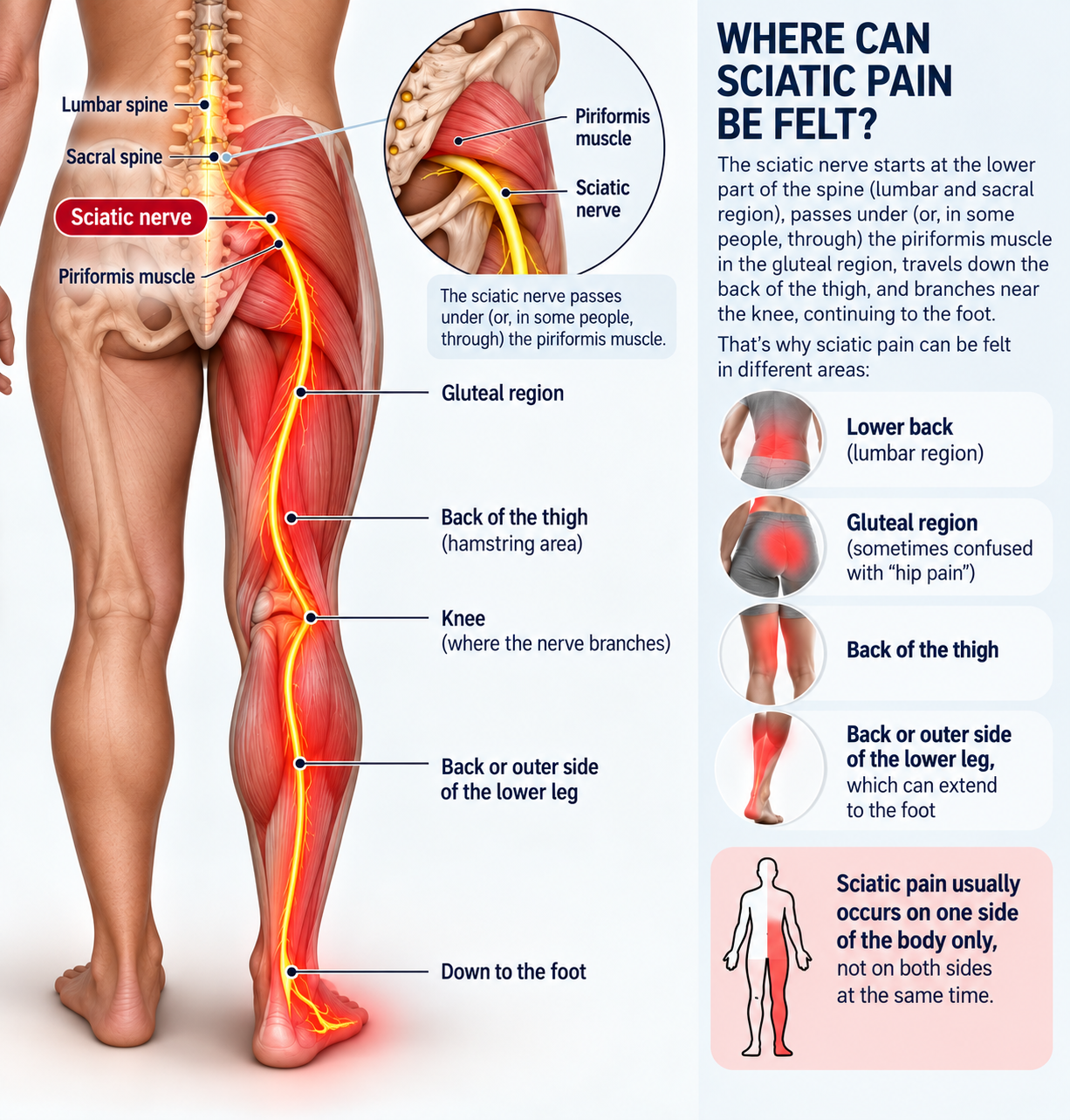
The sciatic nerve begins at the lower part of the spine (the lumbar and sacral region), passes underneath — or in some people, through — the piriformis muscle in the buttock area, runs down the back of the thigh, and branches out near the knee, continuing down to the foot.
Because of this, sciatic pain can be felt in quite different spots:
- Lower back
- Buttock (sometimes mistaken for "hip" pain)
- Back of the thigh
- Back or side of the leg, sometimes reaching the foot
Sciatic pain usually happens on one side of the body only, not both at the same time.
Why does sciatic pain happen?

Researchers and health professionals associate sciatic pain with a few common factors, including:
- Herniated disc — when the disc between spinal vertebrae presses on a nerve root near the sciatic nerve
- Spinal stenosis — a narrowing of the canal through which spinal nerves pass, more common with age
- Piriformis syndrome — when the piriformis muscle, in the buttock area, compresses the sciatic nerve
- Long periods of sitting — poor posture or prolonged sitting can increase pressure on the nerve
- Excess weight — added weight can increase pressure on the spine and nerves
- Weaker supporting muscles (core, glutes) — less-conditioned muscles that support the spine can contribute to the problem
It's important to understand that sciatic pain doesn't have a single cause — which is why identifying the specific cause usually requires evaluation by a health professional (physician or physical therapist), especially if the pain is persistent or recurring.
How can sciatic pain be cared for?
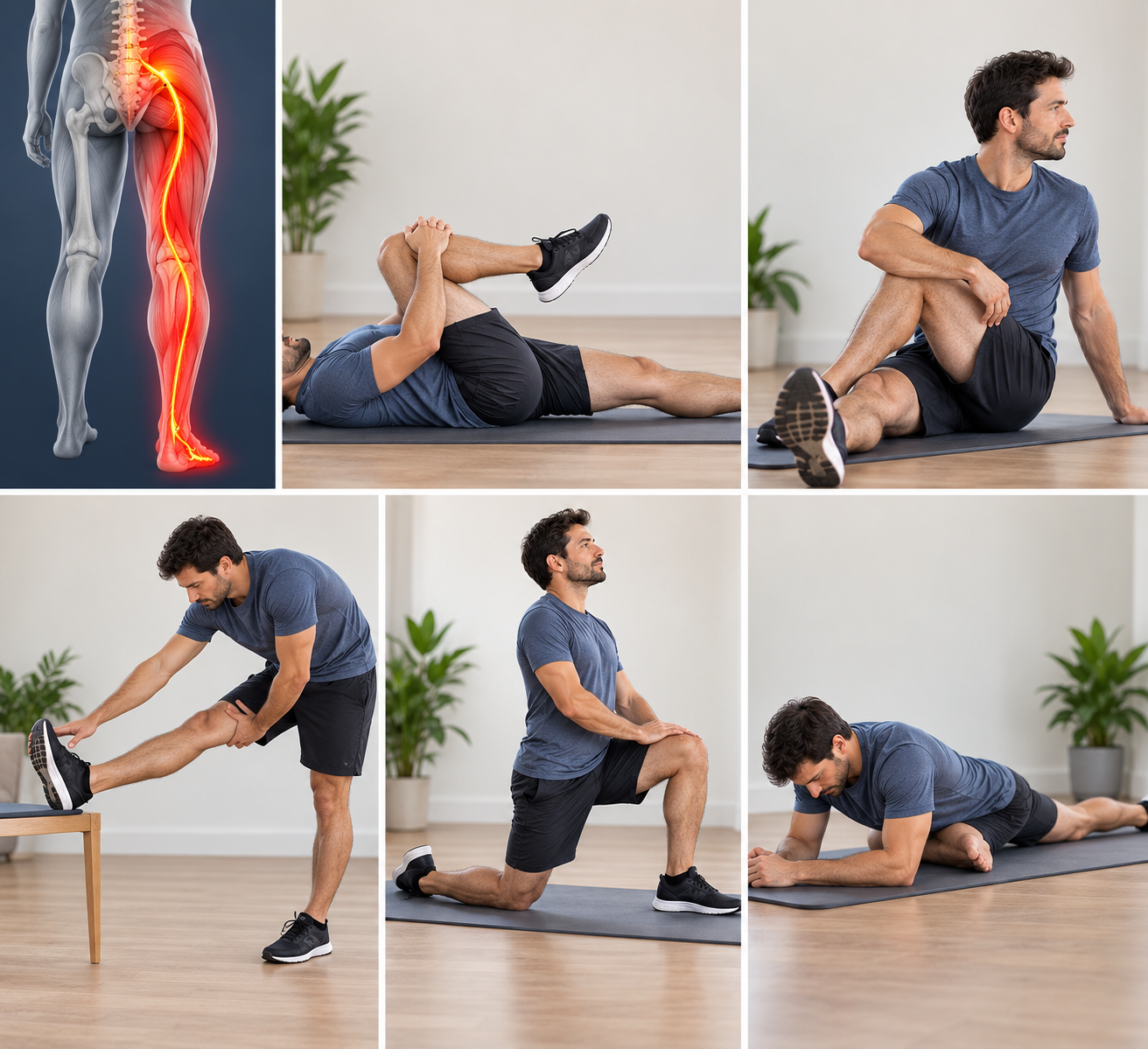
Here's what researchers and health professionals commonly point to as approaches associated with caring for sciatic pain — always keeping in mind that every case is different, and professional guidance is what determines the best approach for each individual:
- Staying moderately active, within a comfortable range — prolonged bed rest tends not to help, and can sometimes worsen stiffness
- Targeted stretches — focused on the lower back, glutes, and back of the thigh, usually guided by a physical therapist
- Strengthening the core and glute muscles — stronger muscles help distribute load on the spine more evenly
- Heat or cold therapy, depending on the stage and professional guidance
- Postural correction, especially for people who sit for many hours
- Physical therapy — generally the most recommended approach for recurring cases
- Medical evaluation for cases of intense, prolonged pain, or pain accompanied by weakness/tingling — imaging tests may be indicated in these cases
Nutrients associated with sciatic nerve health

While nutrition doesn't replace professional evaluation and treatment, some nutrients have been studied by researchers for their role in nerve health and the body's inflammatory process, which may be relevant in the context of sciatica:
Vitamin B12
Studied for its role in maintaining the myelin sheath, which protects nerves. Found in meat, eggs, fish, and dairy.
Magnesium
Associated with muscle relaxation and nerve function. Found in dark leafy greens, nuts, seeds, and whole grains.
Omega-3
Fatty acids studied for their role in the body's inflammatory process. Found in fatty fish (salmon, sardines), flaxseed, and walnuts.
Curcumin
A compound found in turmeric, studied for its anti-inflammatory properties. Can be paired with black pepper for better absorption.
Vitamin D
Studied in relation to bone and muscle health, both relevant in the context of spinal pain. Obtained through moderate sun exposure, fatty fish, and fortified foods.
Vitamins B6 and B1
Part of the B-complex, studied for their role in healthy nerve function.
Complementary nutritional support
In theory, getting all of these nutrients from diet alone is possible. In practice, it would require planning nearly every meal of the day around them — something most people's busy routines make quite difficult.
That's why many people look for a more practical way to secure this daily nutritional support, without relying on getting everything right through diet alone.

A formulation that brings together, in a single daily dose, a combination of B-complex vitamins (B1, B2, B6, B9, B12) and other compounds studied for their role in nerve health — designed for those who want to give their body that support without having to get everything right in their diet every single day.
Disclosure: this is an affiliate link. If you click and make a purchase, we may earn a commission at no additional cost to you. This is not a substitute for medical advice — talk to your doctor before starting any supplement.
Final thoughts
Sciatic pain can have quite different causes from person to person, and what works for one case may not be right for another. If the pain is recurring, intense, or comes with tingling, numbness, or weakness in the leg, the best step is to seek evaluation from a physician or physical therapist — they're the ones who can identify the specific cause and guide the most appropriate care for your case.
This content is for educational and informational purposes only. It does not replace medical or physical therapy consultation, diagnosis, or treatment.